

Let’s talk about … not waiting to maintain concrete structures. Mundane, yes?
The Tension of Costs
Are you caring for a building? A bridge? A wharf? … or just about any other concrete structure? If you are involved in a maintenance budget you’ll be keenly aware of the tension of costs – the work that really needs doing isn’t necessarily covered by the budget.
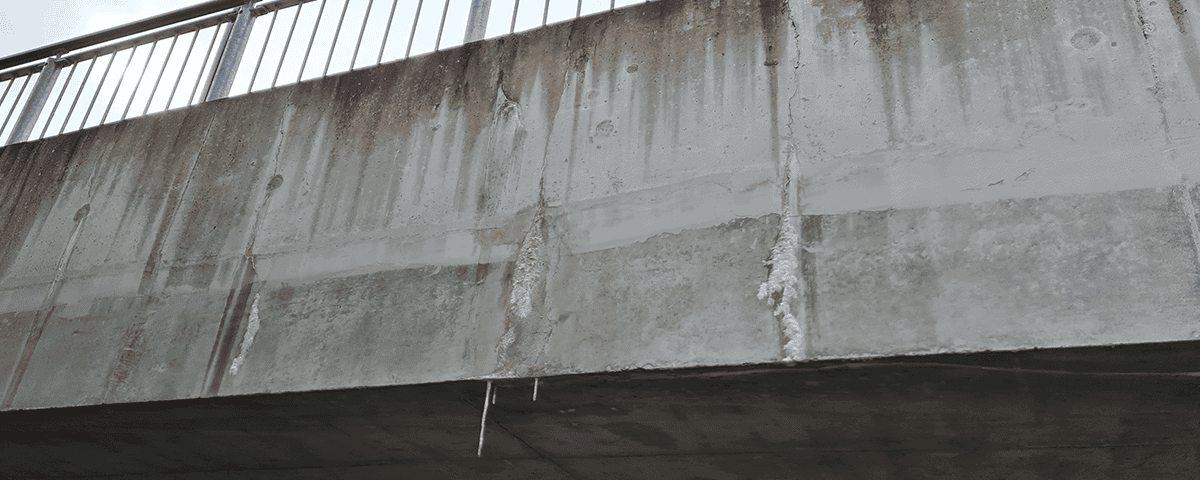
And of course, the older the building grows, the higher the potential maintenance costs. In fact, the process of ageing is a self-driving cycle of deterioration. It goes something like this:
- Concrete is somewhat porous, despite everyone’s best efforts. Moisture carries contaminants into and through the concrete.
- Stresses, ASR and/or corrosion of the steel begin to open fine cracks in the slab. More moisture gets in.
- The cause of the cracks gets worse. The cracks get wider. Parts of the structure start to fall off. The cycle repeats until the structure is unusable.
This is a very simplistic summary. The ageing of any given structure is typically caused by a combination of factors. But the overarching theme is, carry out maintenance as early as possible.
 |
The Tuutti Model
There’s a very helpful diagram originated by Kyösti Tuutti of Lund University, Sweden, that illustrates the urgency of dealing with deterioration. Here’s a simple version, showing the initiation phase and the ‘propagation’ deterioration phase. Notice that at the final point, the structure has ended its working life.
 |
The Advanced Solution
There is an advanced solution. MARKHAM penetrating hydrogel treatments are available to arrest the deterioration and extend that service life – if applied early. With this in mind, we’ve modified the graph slightly, to demonstrate that if treatment is applied in the initiation phase – that’s well before the damages are severe or obvious – then the service life can be significantly extended. Think about what this means for long-term cost savings!
 |
MARKHAM penetrating hydrogels work by immobilising the moisture within the concrete.
Immobile moisture = no movement of contaminants = no feeding the deterioration.
The treatment is remarkably cost-effective. And safe! – with nil VOCs, penetrating hydrogel treatments can be used in the most sensitive environments. Fast! – minimal downtime for the structure.
If you can relate to the scenarios discussed in this article – get in touch today! We’re keen to discuss options with you.
Like to learn more? Try our on-demand webinar, “Risk Reduction in Concrete Construction“.


