“Burn” is not just about the concrete
For data centre designers, fire engineers and builders: the slab is non-combustible. Paints, epoxies and acrylics on top of it may add both fuel and smoke.
Concrete is one of the safest materials you can put in a data hall. It doesn’t burn.
Then the floor gets finished with a paint, epoxy or acrylic coating for dust control and appearance. Years later, another coat goes down around live equipment.
Each layer is thin. Across thousands of square metres, the total is not.
Fire isn’t the only consideration
In a data centre, smoke matters as much as flame. Smoke and soot can travel well beyond a fire and contaminate sensitive equipment. Even a minor incident can mean shutdowns and clean-up.
So for any floor finish, ask not just “will it burn?” but “what does it give off if it does?”
 |
Paints, epoxies and acrylics
Epoxy, polyurethane, acrylic and paint systems form an organic film on top of the slab. Depending on their formulation and fire classification, that film may add combustible material and produce smoke when exposed to fire.
That doesn’t make every coating unsafe. But the film covers the whole floor, and most coatings need recoating, which adds layers and means working around live equipment. So the classification is worth checking, not assuming.
How to check a concrete finish
BS EN 13501-1 classifies how construction products react to fire, from A1 (the highest) down to F. Flooring classifications add the suffix “f l”. Lower classes also carry a smoke rating (s1 to s3). A1 products make no significant contribution to fire, so no smoke rating applies.
Ask any supplier three things: which class, under which standard, and can I see the test report?
- RELATED READING: Is Your Concrete Sealer Adding Fire Load Fuel to Your Data Centre?
The MARKHAM approach
Rather than coating the slab, MARKHAM hydrogel treatments work inside it, reacting with the concrete to create more of its own binding structure (C-S-H). This closes pores, immobilises moisture and helps reduce the carbonation processes associated with surface dusting.
CONQOR PROTECT seals, hardens and controls moisture without leaving a surface film. It has been independently tested to BS EN 13501-1:2018 using ISO 1182 and ISO 1716, and classified A1 / A1fl, the highest reaction-to-fire class (classification report 20250428-002614-10C). No flame retardants are used.
Because the treatment does not rely on a topical film, it does not require the conventional recoating cycle associated with many film-forming finishes. This in turn means no extra layers added over the building’s life.
Real-life example
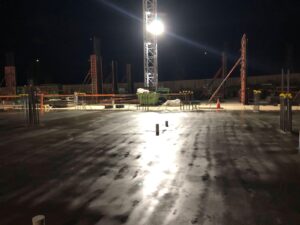
At Project Gemini Data Centre in Takanini, Auckland, MARKHAM used the same inside-the-concrete approach: a hydrogel admixture for waterproofing, followed by a spray-applied hydrogel treatment for curing and anti-dusting protection. The result was protection of moisture-sensitive data hall concrete without relying on a conventional film-forming floor finish.
 |
Questions worth asking
? Has the fire engineer counted floor and surface finishes in the fire load?
? What reaction-to-fire class does the proposed sealer or coating carry, and under which standard?
? Can the supplier provide the test report?
? How often will the finish need recoating, and does each coat add to the fire load?
? Could dust control and protection be built into the concrete instead?
- TO CONSIDER: Fire Risk: A Major Concern for Data Centres
Talk to us before the finish is specified
Specifying floors for warehouses, health facilities, car parks or data centres? Download the CONQOR PROTECT fire classification report, then talk to a MARKHAM specialist about protecting the slab without adding fuel.
If you’re involved in data centre construction, you’ll find our on-demand webinar library useful. For example, try “Unseen Risks: Concrete in Data Centres“.