

Waterproofing for water storage might seem obvious
Concrete is inherently durable and waterproof when properly constructed, making it a suitable material for water storage tanks, particularly where large capacity is required.
However, concrete is not invincible, and deterioration can set in due to a number of factors, including contamination introduced via the water itself. In fact, moisture-borne contamination is a major factor in the corrosion of concrete reinforcing steel and the resultant cracking. Unlike ‘dry’ structures, cracking is obviously a serious challenge for water containment.
Effective repair
So, if you are responsible for the protection and maintenance of a concrete water storage structure, you will sooner or later be assessing its deterioration for repair.
- Save for later: Sheriffs Mountain Service Reservoir – case study download
Do you have a plan for proactive maintenance as part of your remediation works?
MARKHAM penetrating hydrogel treatments are the advanced solution for concrete durability and remediation – used extensively for at-risk structures such as marine structures, water storage, and infrastructure.
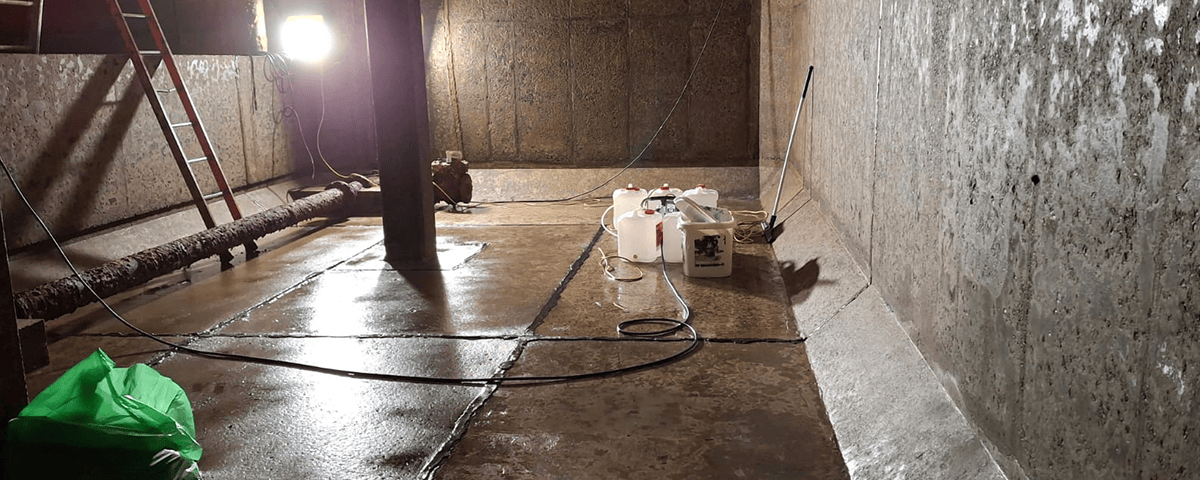 |
| Sheriff’s Mountain Service Reservoir |
Key benefits include:
MORE COST-EFFECTIVE THAN MEMBRANES
…and will not deteriorate over time.
MARKHAM hydrogel treatments are distinctly cost-effective, both immediately, compared to the cost of the equivalent membrane, and in the long term. Because the resulting internal protection does not break down over time and does not require reapplication, the treatment is extremely cost-effective in the long term.
SAFER THAN MEMBRANES
- Concrete hydrogel treatments are induced using waterborne colloidal silicate, which is extremely safe for both the environment and humans in the vicinity – it has no VOCs.
- MARKHAM hydrogel treatments have been successfully used in and around sensitive marine environments to avoid detrimental effects on the waterways.
- MARKHAM hydrogel treatments will not have any adverse effects on applicators or other personnel in the vicinity.
- EPDs are available for key MARKHAM treatments.
This factor makes hydrogel treatments the ideal choice for water containment structures. Overspray is not an issue, as the treatment is completely safe for the environment.
EASE OF INSTALLATION —
Fast and safe, MARKHAM spray-applied hydrogels minimise downtime.
‘Trafficable’ one hour after application, the process will not unduly delay other works proceeding. This is often a significant cost saver.
The treatment can be applied to wet concrete, minimising delays.
PERMANENT PROTECTION AND DURABILITY
- Protect the structure against chlorides and other reactants – e.g. chlorinated water.
- Protect the reinforcement zone. Arrest the corrosion cycle.
Chlorides are particularly aggressive when they approach the reinforcing steel.
By immobilising internal moisture and preventing the ingress of contamination, Aquron 7000 provides permanent protective durability.
Yes, permanent means permanent – there is no need for regular re-coating.
COMPATIBLE WITH OTHER TREATMENTS
MARKHAM spray-applied hydrogel treatments are 100% compatible with paints and coatings designed for bare concrete. Nothing is introduced which is not already found within the concrete itself.
If the tank is to be painted after remediation, the treatments will not cause any delamination or bubbling issues and will not react with the coating.
CHEAPER THAN REPLACING THE WHOLE TANK!
One of the overwhelming benefits of MARKHAM hydrogel treatment is that it helps the concrete last longer.
- Moisture-borne contaminants are immobilised.
- The reinforcing steel is protected.
- Adverse reactions are arrested.
- The service life of the concrete is preserved or extended.
Say no more!
Get in touch today to discuss your particular project requirements.
It’s important to understand that each structure must be assessed individually. MARKHAM treatments can boost the effectiveness of other treatments such as cementitious spall repairs, as they helps avoid Incipient Anode Formation.
MARKHAM treatments can enhance self-healing within the concrete for cracks up to 0.5mm. Cracks larger than this may need further treatment. Any risk of structural movement must be taken into account.
Looking to learn more about concrete durability? Try our on-demand webinar, “Concrete – Waterproofing – Durability“.


