

What Does ‘Early Cracking’ Mean?
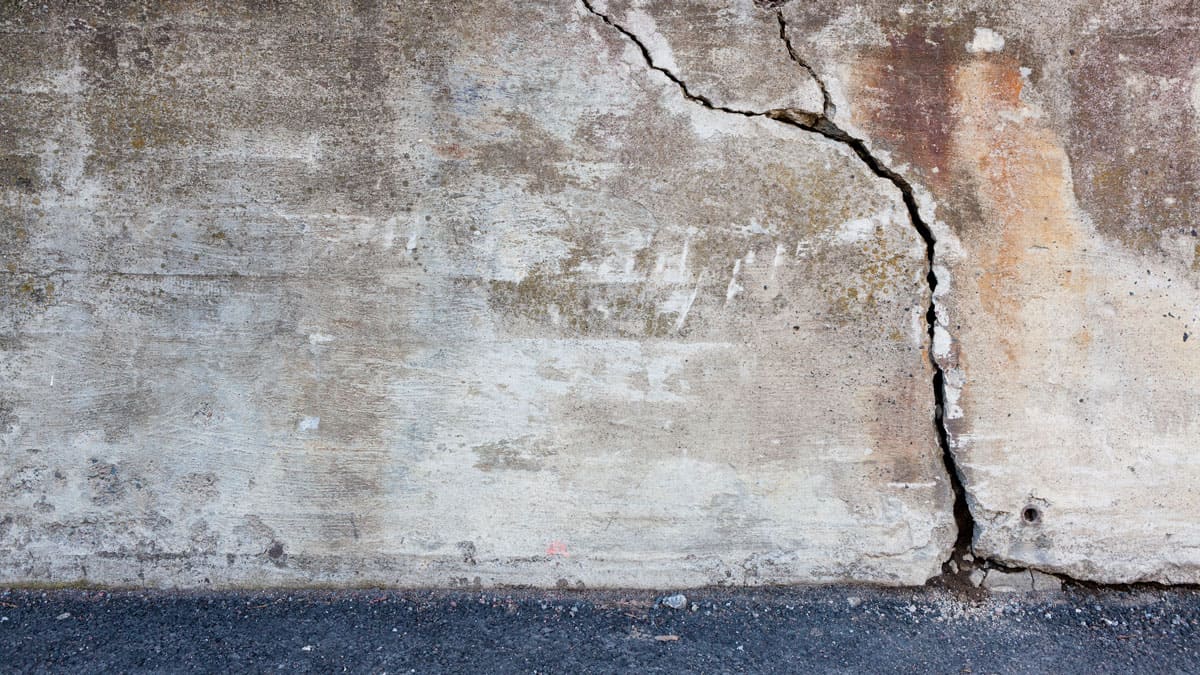
Early cracking in concrete can be defined as developing within the first 7 days after casting or placement. It’s a common problem, so much so that it may not be given much attention in the field. It is certainly the focus of much industry discussion, however, and if you’re actively involved in mix design or project coordination, we’re not telling you much you didn’t already know.
In the context of precast concrete, it might be logical to believe that superior control of the conditions under which the concrete is poured leads to consistently better results and reduced cracking. Unfortunately, in the real world, this isn’t necessarily the case.
Causes
There are multiple possible causes, resulting from a combination of the mix composition, the exposure environment, the hydration rate, and other curing conditions. However, the two most common generic causes are (1) insufficient cover (settlement cracking) or (2) inefficient hydration (shrinkage cracking).
Insufficient cover
Insufficient cover refers to the reinforcing steel being too close to the surface of the concrete. As the concrete cures and settles, cracks open over the steel. This is called settlement cracking.
It’s also important to understand that even if settlement cracking doesn’t develop, insufficient cover means that the steel has less protective concrete between it and the elements, and the risk of corrosion over time is greatly increased.
Inefficient hydration
The most common cause of inefficient hydration is moisture evaporating too quickly from the concrete’s surface, causing the outer layer to dry prematurely and resulting in shrinkage cracking.
In the context of precast elements, another potential cause of inefficient hydration occurs with steam curing. Elements that are overheated during curing may not fully cure within the concrete matrix, increasing the risk of delayed ettringite formation (DEF) as the concrete ages.
 |
Long-Term Results
Early cracking increases the likelihood of a reduced service life due to premature deterioration.
The reason for this is that reactive contaminants are carried by water, including moisture vapour. Their reactivity also depends on moisture. Chloride, potassium, and other reactive ions move into and around the concrete’s porosity, and cracks provide an open gateway for their entry.
What happens then? Either the concrete itself may react (e.g. ASR, DEF or carbonation) or the reinforcing steel may corrode. Very likely, more than one reaction will occur simultaneously. These reactions are not immediate but occur over time and have expansive effects within the concrete, causing further, more severe cracking.
You can see where this is going. Little cracks cause big cracks, and big cracks end up making the concrete fall apart. Yes, of course, that’s putting it simplistically – but the deterioration cycle is very real.
What Happens in the Real World?
As noted, there is already much industry discussion on the underlying causes of cracking. Mix designs and casting techniques are clearly defined.
What happens in the real world? Local materials, ambient weather, or substandard casting practices can conspire to nullify the best intentions of the design engineers.
It would be excellent if each precast yard identified its risk factors to eliminate potential defects. However, contributing factors are not always clearly identifiable, and microcracking is often overlooked.
 |
Real World Solutions?
There is a solution available which can be used proactively to arrest the deterioration cycle from day one: concrete hydrogel treatment.
Available in both admixture and spray-applied variants, hydrogel treatments are effective for a very wide spectrum of cracking issues. By immobilising moisture – preventing its entrance or movement within the concrete – contaminants are prevented from entering, moving, or continuing to react. This breaks the deterioration cycle. By forming a C-S-H non-expansive hydrogel, existing cracks and porosities can be closed.
- If applied at the time of casting, MARKHAM hydrogels will enhance hydration, minimising shrinkage cracking.
- If applied after cracks have become apparent, MARKHAM spray-applied hydrogel will initiate self-healing of non-moving cracks up to 0.5mm.
- Further, spray-applied hydrogel can compensate for low cover by increasing the impermeability of the concrete, equivalent to doubling the effective cover of the concrete!
Involved in the production of new precast concrete? Talk to us about protecting the durability from day one.
Faced with expensive defect replacements in the yard? Maybe we can help you rescue a non-conforming element.
Seeing early deterioration on recent structures? Let’s talk about arresting the cycle of deterioration.
Get in touch today. We look forward to hearing from you!
Like to dive deeper into concrete real-world challenges? Try our on-demand webinar, “Risk Reduction in Concrete Construction“.


